
Running a Sex Offender Check in Morris County
The Texas Public Sex Offender Registry is the main public channel for a Morris County registry check. Texas DPS publishes records received from the law-enforcement authority that registers each person. A city resident generally reports to the police authority for that city. Someone living outside an incorporated city reports to the county authority, which means the Morris County Sheriff's Office is the starting point for rural county registration questions.
Start with the question you need to answer. A Morris County filter gives a broad community view. A city, ZIP code, or street search is better for a defined place, while a name search is useful when the spelling and identity details are known. The result is a statutory registration record, not a finding that someone poses a current threat. Confirm the full profile, status, registering agency, and official address before relying on a result.
Morris County Registry Channels
Morris County has no separate county registry database documented in the official research. The practical route is the DPS public registry, backed by the local registering authority. City residents should first confirm the correct registration arrangement with Daingerfield, Lone Star, or Naples police. Residents beyond city limits can call the Morris County Sheriff's Office at (903) 645-2232 or visit 502 Union Street in Daingerfield. The sheriff page is the official county contact even though it does not publish a special registry-unit title or counter schedule.
The Texas DPS registration-program overview explains how local authorities pass registration data to the statewide system. The program image below shows the state source behind Morris County registry information.
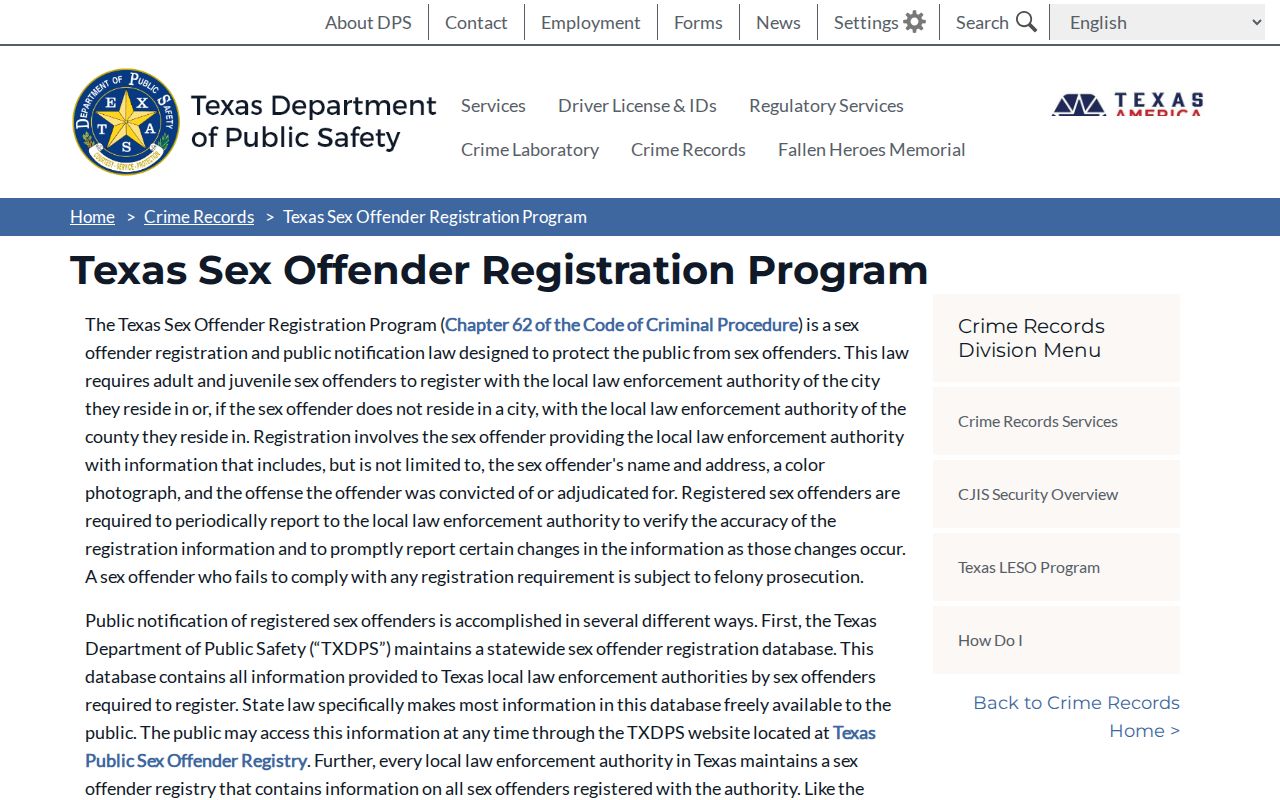
That state and local split matters when a profile needs review: DPS runs the public site, but the named registering authority is best placed to check a local address or compliance detail.
Searching the Texas Public Sex Offender Registry
The free Texas registry provides both name and geographic paths. Labels can shift as DPS updates the portal, so use the purpose of each field rather than assuming an old screen will stay fixed. A careful Morris County search proceeds in four steps:
- Open the official DPS registry and review its conditions before choosing a name or geographic search.
- For a county view, select Morris. For a smaller area, enter Daingerfield, Lone Star, Naples, a ZIP code, or an address and radius.
- Review the list or map and compare the name, photo, address, and registering agency. Do not treat a nearby map pin as an identity match.
- Open the profile and read the status, offense, registration dates, and other published details. Contact the listed authority if the address appears stale.
The official registry search form is the source for the field inventory below. Its screen offers more than a simple surname box.
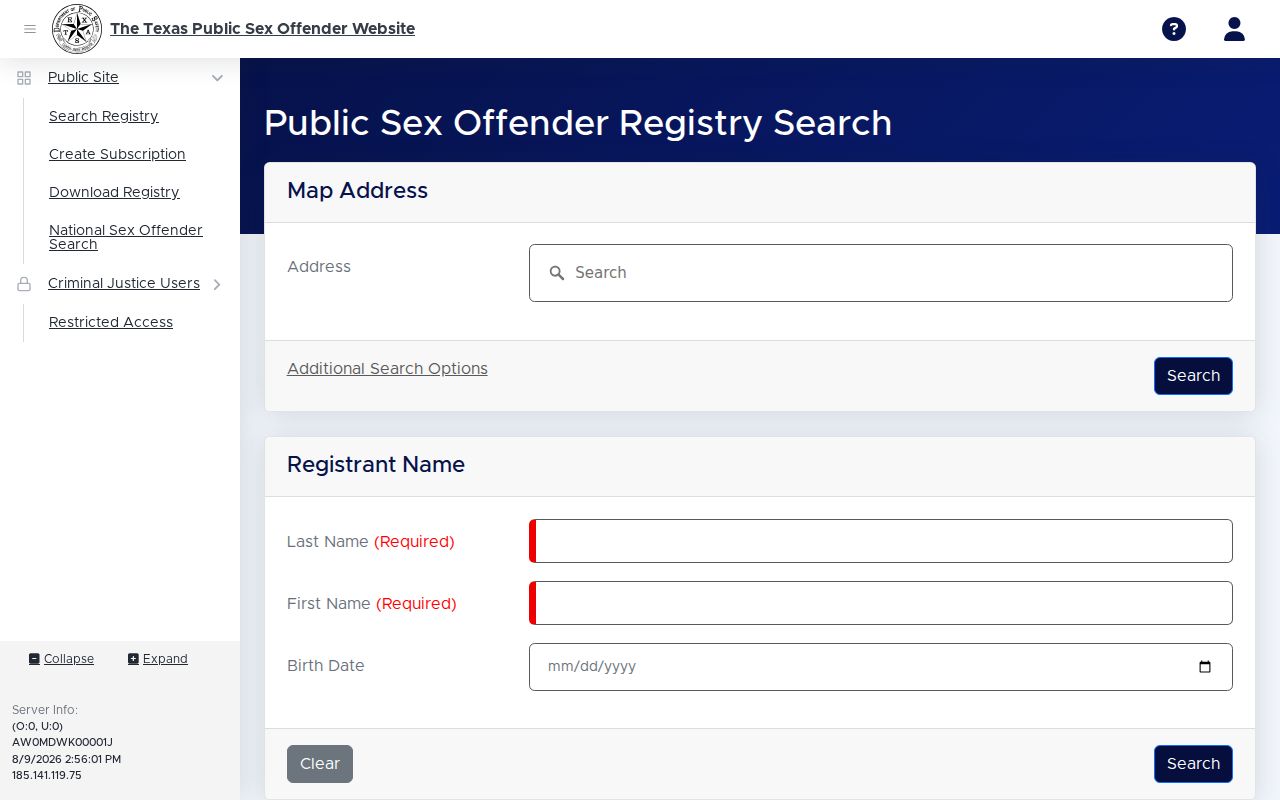
The search form lets a Morris County reader move from a broad Morris County list to a more precise city, address, or name query without using a commercial people-search service.
| Field | Type | Search Route | Use |
|---|---|---|---|
| Last Name | Text | Name | Primary name field; confirm live partial or exact behavior |
| First Name | Text | Name | Narrows a surname result |
| Middle Name | Text | Name | Optional added narrowing |
| Address | Text | Geographic | Street or address input |
| City | Text or dropdown | Geographic | Use a Morris County city |
| County | Dropdown | Geographic | Select Morris for a county-wide result |
| ZIP Code | Text | Geographic | Narrows the area |
| Radius | Dropdown | Address | Available distances are shown live |
| Search / Clear | Buttons | Both | Run or reset the selected query |
What a Registry Profile Shows
A Texas public profile combines identity, address, offense, and registration information that state law permits DPS to disclose. Fields can differ by case. Readers should not expect each Morris County profile to display every item in the table, and they should distinguish the public fields from information collected only for law-enforcement use.
| Name and Aliases | The registered name and known aliases used to help distinguish identities. |
|---|---|
| Photo and Description | A color photo plus sex, race, height, weight, hair, eyes, age or birth information, and possible scars, marks, or tattoos. |
| Registered Address | The published residence and registering agency, subject to updates and geocoding limits. |
| Offense Details | The reportable offense, statute, and conviction or adjudication information, with victim age or sex category when lawful. |
| Registration Details | Status, registration dates, and other duties or descriptors made public by DPS. |
| Other Published Data | School or institution relationship data and, for specified trafficking offenses, vehicle information may appear. |
A Morris County profile is a point-in-time official record. It should be read with its status and dates, not reduced to a photo or map location.
Morris County Registry Privacy Limits
Registration does not make every collected detail public. Texas excludes Social Security and driver's-license numbers, personal phone numbers, online identifiers, employer contact information, victim-identifying data, and additional information DPS designates as protected. A Morris County registry search therefore cannot serve as a complete investigative file. The omission of a field may reflect a statutory boundary, not a database error.
Juvenile treatment also differs. A juvenile court may order registration nonpublic or alter the duty under the governing rules. That is one reason a public search cannot be used to infer that no legal process exists. DPS may hold information that the public-facing profile must not show, while a court may control whether a juvenile entry appears at all.
Registration Requirements and Levels in Texas
Texas does not place every public profile into a simple federal-style Tier I, II, or III label. Chapter 62 ties duration and verification to the offense, statutory subsection, status, and prior qualifying duties. A profile label alone cannot replace the governing offense table. The framework below states only the general rules documented by DPS and the statute.
| Texas Category | General Duration | Visibility or Verification Note |
|---|---|---|
| Lifetime offenses or repeat qualifying duties | Lifetime | The exact offense and subsection control; verification may be annual, every 90 days, or otherwise status dependent |
| Other qualifying adult reportable offense | Generally 10 years after discharge | Confirm the profile and Chapter 62 duty |
| Juvenile registration | Court and statute dependent | A court may alter the duty or make registration nonpublic |
| Civilly committed sexually violent predator or high-risk notice | Enhanced or lifetime context | DPS community postcard notification may apply |
Discharge and early-termination rules can change the calculation. Ask the Morris County registering authority or a qualified Texas attorney about a specific duty rather than assigning a tier that Texas does not publish.
Morris County Searches Beyond Texas
A Texas-only search can miss a registration maintained by another state, tribe, territory, or federal jurisdiction. The Dru Sjodin National Sex Offender Public Website, or NSOPW, provides a cross-jurisdiction layer. It is useful when someone recently moved, an address lies near a state line, or the correct registration state is not known.
The official NSOPW site shown below routes queries to participating public registries rather than replacing the Texas record source.
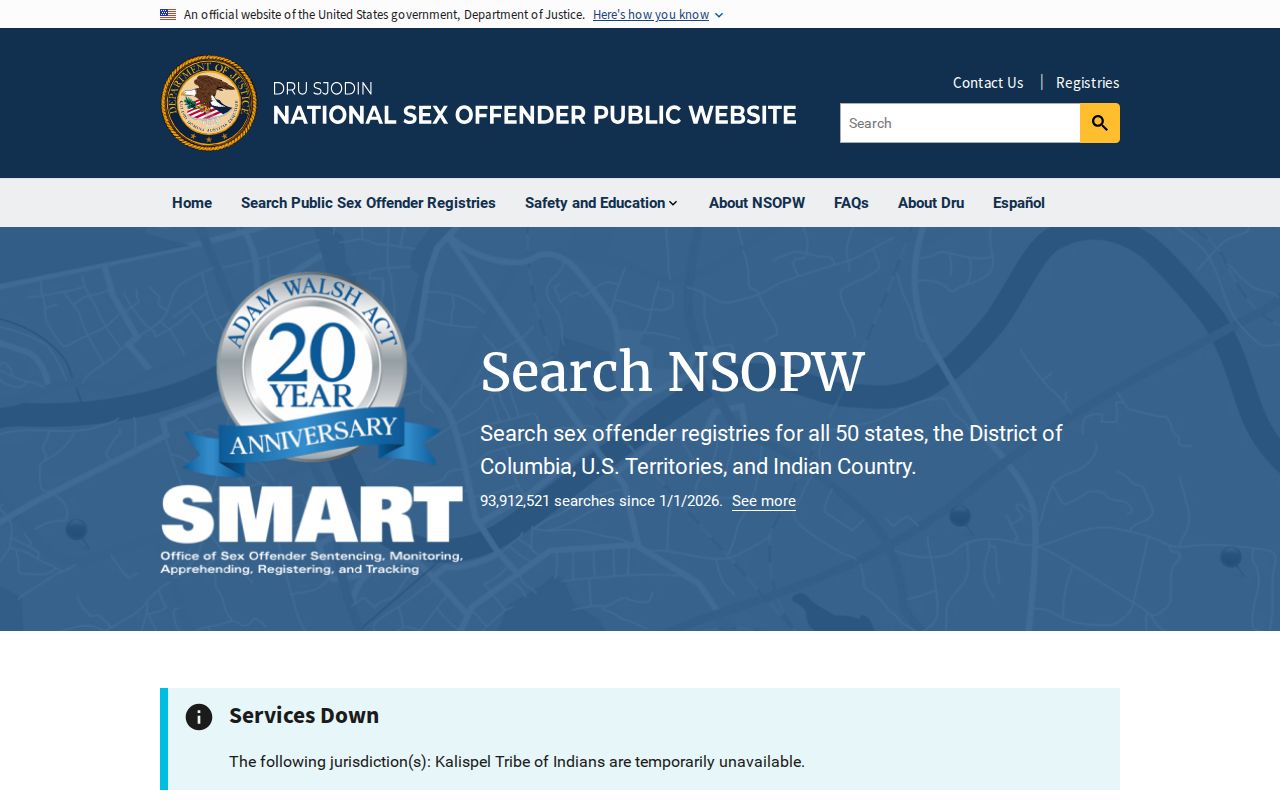
When NSOPW and Texas results differ, open the source-jurisdiction profile and contact that registry's official authority. A Morris County address should still be checked in the Texas portal because update timing and search rules can vary.
Morris County Registry Notifications
Public notice in Texas has more than one form. DPS publishes the statewide database, local agencies may maintain permitted registry information, and publication may occur where Chapter 62 allows it. DPS also describes mailed postcards when a high-risk offender or a civilly committed sexually violent predator enters a community. A postcard is an enhanced notice channel, not proof that every Morris County move will generate mail.
If a Morris County address looks old, first compare the full profile and its dates. Then contact the named registering authority. Outside city limits, use the Morris County Sheriff's Office. Within a city, confirm the police registration arrangement. Report suspected failure to register rather than posting an accusation online. Officials can compare the public record with required check-ins and address reports that are not open to the public.
Lawful Use and Community Notification
The registry exists for awareness and safety planning. A Morris County search can help a family understand an official notice, check a neighborhood address, or verify which agency holds a registration. It cannot predict future conduct, establish that a person is currently guilty of a new act, or authorize private enforcement. Use the official profile and contact channels. Do not rely on copied listings or social-media claims.
Use registry data lawfully: Texas Code of Criminal Procedure Chapter 62 does not permit registry information to be used to injure, harass, threaten, or commit a crime against a registrant or household. Misuse can itself be prosecuted.
For a suspected compliance issue, notify the registering police authority or Morris County sheriff. For an immediate threat, call 911. Those channels protect both community safety and the accuracy of the official process.