
Morris County Felony Court Records
The 76th and 276th Judicial District Courts hear Morris County felony matters. Both sit at the county courthouse in Daingerfield, and District Clerk Gwen Ashworth keeps their files. These are separate trial courts, but a reader uses the same district clerk channel for either one. A cause number is the cleanest key. A defendant name and an estimated filing year can help when the number is unknown.
The Morris County District Clerk page identifies the judges, the public-access route, and the clerk contact. That official page is also the source for the view below.

The image helps distinguish the felony custodian from the county clerk, who keeps a different class of Morris County criminal case records.
Criminal Cases in the Morris County Courts
Morris County routes a case by jurisdiction, not by one broad county label. The district clerk keeps felonies filed in the two district courts. County Clerk Brittany Andrews keeps Class A and B misdemeanor files for the constitutional County Court. The Morris County Justice Court handles fine-only state or county citations and magistrate work. Daingerfield and Naples municipal courts retain matters filed in their city jurisdictions.
This split matters when a portal search returns nothing. A Daingerfield Class C citation may never become a district or county court case. In contrast, an arrest made inside a city can still produce a felony file with the Morris County District Clerk. The filed charging instrument determines the court trail. For broader context about the earlier custody record, compare the county's arrest history channels with the clerk record.
Note: The arresting agency does not decide which Morris County clerk will keep the final filed criminal case.
Morris County Public Case Portal
Both clerk pages publish a Tyler Technologies public-access link with the username Public and password Public. The live vendor form was access-gated during research, so its menus, date range, wildcard rules, and image coverage are not stated here. Use only the controls shown by the portal when it opens. If an image is locked or missing, move to the clerk rather than treating a blank screen as proof that no case exists.
The Morris County portal access gate and the clerk-assisted search support these confirmed inputs:
| Field or Key | Type | Required | Morris County Use |
|---|---|---|---|
| Username | Text | Portal gate | Enter the county-published value Public |
| Password | Text | Portal gate | Enter the county-published value Public |
| Defendant name | Name | One search route | Use a full name and confirm identity from the case |
| Cause number | Text | Best when known | Direct key for a clerk request or portal search |
| Filing year | Year | No | Helps the clerk narrow similar names and older files |
re:SearchTX offers a second route for e-filed Texas material. Its Morris County coverage and document visibility can differ from the local system, so the originating clerk remains the authority for a certified court event.
How to Search Case Records
Begin with the alleged offense level and court, then use the narrowest identifier available. This avoids sending a municipal citation to the felony desk or a district indictment to the county clerk.
- Decide whether the matter is a felony, Class A or B misdemeanor, or fine-only citation. If unsure, ask the arresting agency or a clerk which court received it.
- Open the relevant District Clerk or County Clerk page and follow its Public Access link.
- Sign in with the published Public/Public credentials. Search by cause number when known, or use the defendant name and likely filing year.
- Read the docket in date order. Check the charging instrument, plea, orders, disposition, and judgment instead of relying on the first charge description.
- Call or visit the correct clerk for an older file, a missing image, or a certified disposition. Ask about the current copy charge before ordering.
Statewide re:SearchTX can supplement the local portal. Registration may be needed for some documents, local integration varies, and sealed or confidential filings do not become public through the statewide layer.
Morris County Misdemeanor Case Files
County Clerk Brittany Andrews holds the criminal misdemeanor files for the Morris County Court. The office is in Suite D at 500 Broadnax Street, Daingerfield, Texas 75638. Its counter runs from 8 a.m. to noon and 1 p.m. to 4:30 p.m. The direct number is (903) 645-3911. A phone call can confirm whether the office has the cause and what is needed for a certified copy.
The official County Clerk page confirms the misdemeanor role and portal route and supplies the source for this image.
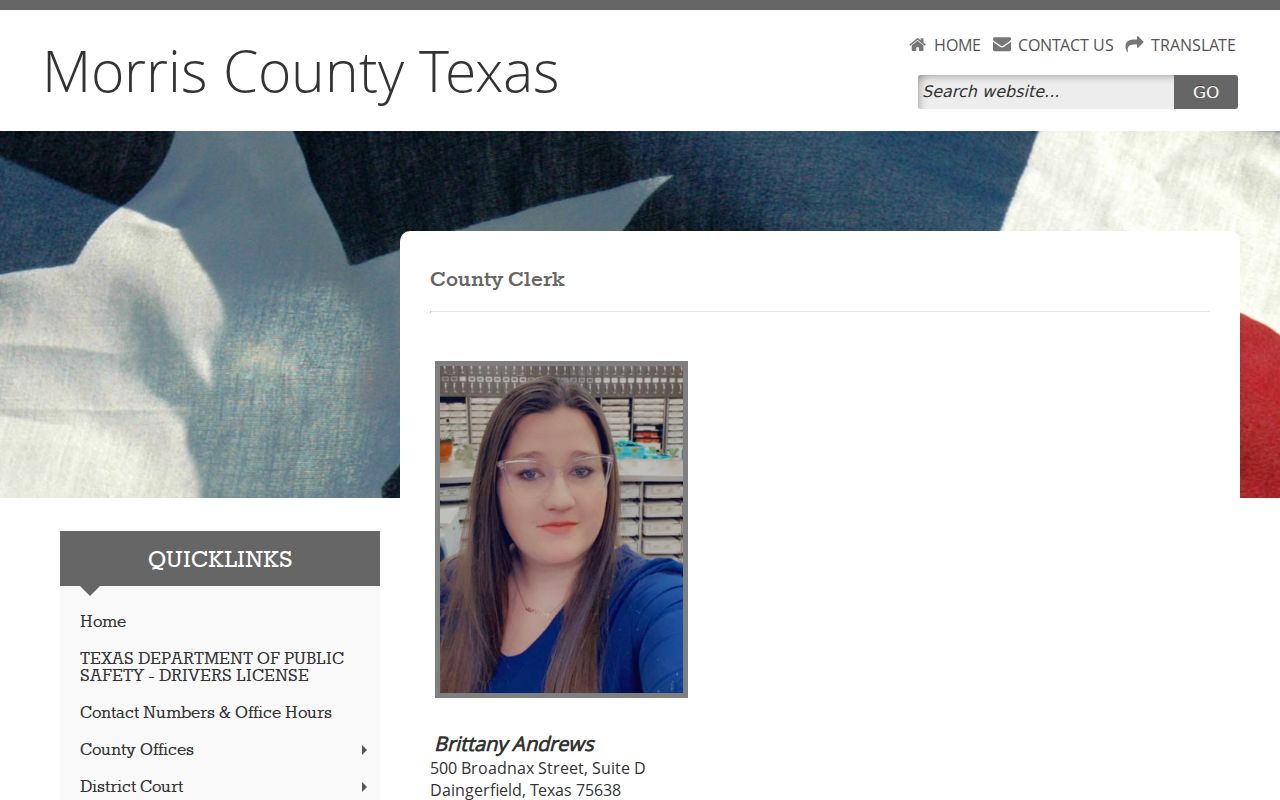
The screenshot marks the right starting place for Class A and B case records, which should not be confused with fine-only municipal or justice court dockets.
Morris County Clerk
500 Broadnax Street, Suite D
Daingerfield, TX 75638
(903) 645-3911
Counter: 8 a.m.–noon and 1–4:30 p.m.
Morris County District Clerk
500 Broadnax Street, Suite J
Daingerfield, TX 75638
(903) 645-2321
Felony files and district orders
What the Case File Shows
A Morris County criminal case file is built around the cause, court, filed charge, and judicial action. The public screen may summarize the file while the clerk-held record contains the actual complaint, information, indictment, order, or judgment. Protected identifiers and sealed documents should be redacted or absent.
| Cause Number & Court | Identifies the Morris County case and the court with jurisdiction. |
|---|---|
| Charging Document | Shows the complaint, information, or indictment and the charge accepted for filing. |
| Docket Entries | Lists settings, filings, motions, orders, and other events in date order. |
| Bond & Capias | May record release security, a court writ, and later changes. |
| Plea & Disposition | Shows the plea and whether a charge was dismissed, deferred, tried, or resolved another way. |
| Judgment & Sentence | States the final court order, sentence, fines, costs, and qualifying supervision terms. |
A portal entry is a finding aid. When the outcome must be established from an official document, ask the Morris County clerk for the judgment, dismissal order, or other certified disposition.
Morris County Charges Can Change
An officer's initial arrest charge begins one record stream. The prosecutor then reviews the facts and chooses whether and what to file. A misdemeanor may proceed through a complaint or information. A felony generally moves through a grand jury indictment. That review can change the offense level or wording, and it can end without a filed case.
The Morris County District and County Attorney page identifies Ricky Shelton's office at Suite I and is the source for the image below.
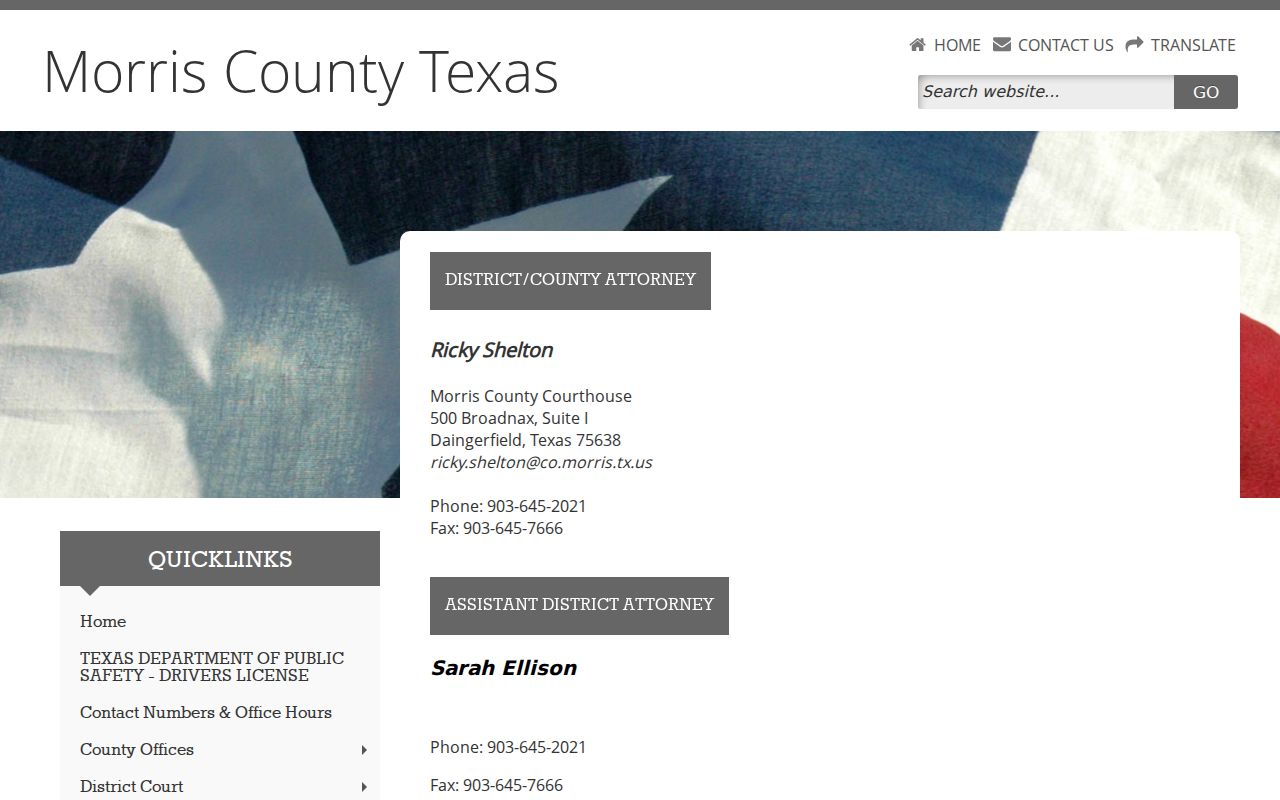
The prosecutor represents the State but is not the custodian for every report or court record. Request filed pleadings and judgments from the clerk, and request an arrest report from the agency that created it.
Stages of a Criminal Case
A Morris County case can start with arrest and magistration, followed by prosecutor review. The formal case begins when a complaint, information, or indictment is filed. Arraignment addresses the charge and plea. Pretrial settings allow motions, discovery work, and negotiations. A plea or trial then leads to disposition and, when applicable, sentencing. An appeal can add another court record after judgment.
Case flow: Charges Filed › Arraignment › Pretrial › Plea or Trial › Disposition › Sentencing
The dates will vary by cause. Morris County research does not support a fixed time for each stage, so use the docket and the clerk's current setting information rather than a generic estimate.
Morris County Case Outcome Terms
Short docket terms can alter the meaning of a Morris County criminal court record. Read the latest signed order and not just a status label.
- No-bill
- The grand jury declined to return an indictment.
- Dismissed
- The prosecutor or court ended the charge without a conviction.
- Deferred adjudication
- A plea or finding is held without a final conviction while court-ordered supervision is completed; DPS may still report it publicly unless it is nondisclosed.
- Acquittal
- A not-guilty result after adjudication.
- Capias
- A court writ directing that a person be arrested.
These terms are not interchangeable. A no-bill addresses an indictment decision, while dismissal ends a filed charge. Deferred adjudication also differs from both a dismissal and a final conviction.
Access & Restrictions
Texas court files are often open, but public access is not unlimited. Juvenile material, protected victim or minor details, Social Security numbers, and sealed documents can be withheld or redacted. An expunction under Code of Criminal Procedure Chapter 55A can direct covered records to be destroyed or returned. An order of nondisclosure restricts public release while preserving access for authorized agencies.
Government Code Chapter 552 governs public information, while Government Code Chapter 411 governs criminal-history dissemination and nondisclosure. Court records also follow judicial access rules.
A missing Morris County online result can mean the wrong court, an older or image-locked file, a lag in posting, or a lawful restriction. Call the correct clerk. Do not infer an outcome from absence alone.
Certified Morris County Case Outcomes
A certified disposition is the safer record when the exact outcome matters. For a Morris County felony, ask the District Clerk in Suite J for the judgment, dismissal, acquittal, or other signed order. For a Class A or B misdemeanor, use the County Clerk in Suite D. Fine-only matters remain with the justice or municipal clerk that filed them.
Give the clerk the cause number if available. Otherwise, provide the defendant name and likely filing year. Ask which document proves the needed event, whether it is public, what the current copy or certification charge is, and how the clerk can deliver it. The County Clerk directs public-information requests to writing. Ask either clerk whether mail, electronic delivery, counter inspection, or another written route fits the requested court record. The research found no published Morris County certified-copy price for these criminal records, so the office must confirm the amount.
Note: A portal screenshot can aid a search, but the originating clerk authenticates the Morris County criminal court outcome.